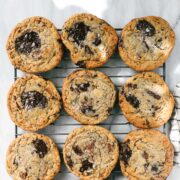
How to Make Chocolate Chip Cookies
In this guide on How to Make Chocolate Chip Cookies, you'll get a look at everything you need to know to make the very best chocolate chip cookies, including how to cream butter and sugar, which ingredients are best, step-by-step instructions and photos, and all the success tips you need.
Servings: 24 cookies
Calories: 252kcal
Ingredients
- 350 g all-purpose flour 2½ cups
- 1 teaspoon baking soda
- ½ teaspoon baking powder
- 1 teaspoon salt
- 226 g unsalted butter 1 cup softened to a cool room temperature
- 213 g brown sugar 1 cup
- 99 g granulated sugar ½ cup
- 2 large eggs 100g room temperature
- 1 teaspoon vanilla extract
- 227 g bittersweet chocolate 8oz
- 113 g milk chocolate 4oz
- Flaky sea salt for sprinkling
Instructions
Prepare the Ingredients
- Flour: Use a kitchen scale to weigh the flour in grams. This recipe calls for 350g all-purpose flour, which is 2 ½ cups when using 140g of flour per cup.There is no standardized way to measure flour using cups, and doing so will produce variable results. Depending on the person, someone may measure 1 cup of flour as anywhere between 120 and 150g of flour. That’s a difference of about ¼ cup of flour. That’s why measuring with a kitchen scale in grams is the best way to get a precise result and the right texture in your cookies.
- Butter: Ensure the butter is at a cool room temperature. You should be able to bend the butter without it breaking or falling apart.
- Granulated Sugar and Brown Sugar: Weigh the granulated sugar and brown sugar. They can be kept in the same bowl. Brown sugar can be packed down at different rates. Using a kitchen scale provides accuracy.
- Eggs: Ensure the eggs are at room temperature. To bring them to room temperature quickly, place the eggs in a bowl of warm, but not hot, water for 1 minute.
- Chocolate: Use a kitchen scale to weigh the chocolate. Cut the bittersweet and milk chocolate into chunks of various sizes, up to ½ inch chunks. You will end up with shards of chocolate, which add chocolate flavor throughout the cookies, and chunks of chocolate, which create luscious puddles of chocolate in the cookies to sink your teeth into.
Make the Chocolate Chip Cookie Dough
- Combine Dry Ingredients: In a medium bowl, combine the flour, baking soda, baking powder, and salt. Stir thoroughly to ensure that the baking soda, baking powder, and salt are well incorporated.
- Set Up the Stand Mixer with Butter and Sugar: In the bowl of a stand mixer, add the softened butter, brown sugar, and granulated sugar.
- Cream the Butter and Sugars: Beat on low speed with the paddle attachment just until the ingredients are incorporated.Increase to medium speed for 2 minutes.Use a spatula or large spoon to scrape down the bowl and the paddle attachment. Beat for 1 more minute at medium speed.Scrape down the bowl and paddle again.Beat again for 2-3 minutes at medium speed. The mixture will become fluffier and noticeably paler in color. Keep in mind that the timing will depend on the exact temperature of the butter and speed of the mixer.
- Add the Eggs: Crack the eggs into a separate bowl. Add the vanilla extract and whisk them all together. Add the egg mixture to the creamed butter and sugar in two increments, mixing in between. Continue mixing at medium speed until the egg mixture has been fully incorporated and the dough is homogeneous, scraping down the bowl as needed.
- Flour Mixture: Add the flour mixture and combine on low speed for 30 seconds to 1 minute, until most, but not all, of the flour is incorporated. Stop mixing while you still see raw flour that's not yet incorporated. Remove the bowl from the stand mixer and use a spoon or large spatula to mix in the remaining flour. Mix as little as possible.
- Add the Chocolate: Add the chopped chocolate and continue mixing by hand until it has been fully incorporated, minimizing the number of times you are moving around the dough with the spatula. Finishing the dough this way, by hand, with as little mixing as possible helps to prevent overly tough and chewy (like pizza crust) cookies.
- Refrigerate: Scrape the dough down and press it into the bottom of the bowl. Then press plastic wrap over the dough to prevent it from being exposed to any air. Place the bowl in the fridge overnight.Refrigerating the dough enables the dough to hydrate. The flour will absorb more of the liquid from the butter and the eggs, which creates a more flavorful cookie. It’s like a lasagna that’s better the next day. Hydrating the dough also helps give the cookies a more caramelized color.
Bake the Cookies
- Prepare the Oven: When ready to bake, preheat the oven to 350°F for at least 30 minutes.
- Portioning Cookies: Portion out ¼ cup, about 2oz, of cookie dough for each cookie. You can do this with a measured cookie scoop or with a quarter-cup measuring cup. Shape the cookie roughly into a round drop of dough.Place 6-8 cookies per baking sheet.
- Bake: Place the baking sheet in the oven and bake at 350°F for 11-13 minutes.For even airflow, bake the cookies one tray at a time (I always do this).Rotate the baking sheet halfway through (I don't usually do this, but it's technically helpful for evenly baked cookies, especially if you have hotspots in the oven).
- Checking Doneness: The outside of the cookies should be a light golden brown, and the center should look slightly underdone for a soft, chewy center (they will continue to firm up on the hot pan after you take them out of the oven). For cookies that are well done throughout, add an extra 1-2 minutes to the baking time and look for a more even light brown color across the tops of the cookies.
- Flaky Sea Salt: Once the cookies have been removed from the oven, immediately sprinkle the cookies with flaky sea salt. Let the cookies cool on the baking sheet until they have firmed up and can be transferred to a cookie drying rack if needed. If you don’t need the baking sheet, you can leave them to cool on the baking sheet fully.
Notes
- Weighing Ingredients: Weigh your ingredients, in particular your flour. Flour is the most important ingredient to measure. If you do not have a kitchen scale, use the dip-and-sweep method to measure flour. This will get you close to 140g per cup of flour, which is the ratio of flour per cup that I use.
- Consider ordering a kitchen scale if you really want to make a great cookie. I like waterproof kitchen scales.
- Butter Temperature: To properly cream butter and sugar, the butter really needs to be at a cool room temperature. And on that note – cream your butter and sugar (roughly 5-6 minutes). This helps with the texture of the cookie.
- High-Quality Chocolate: Use high-quality chocolate. Choose the highest quality available to you within your budget. This is one of the biggest ways to improve the quality of your cookies.
- Chocolate Baking Bars: Use chocolate bars that can be chopped, rather than chocolate chips.
- Stand Mixer: A stand mixer is helpful, but this can be done with a hand mixer as long as you have a patient arm.
- Overmixing: Do not overmix the dough, which develops gluten. I had never had overmixed, tough and chewy cookies until recently, when my 8-year-old son took the lead in making chocolate chip cookies. He ended up overmixing the dough with a hand mixer. The result, while still melty and chocolatey, was almost inedible because of the really unpleasant, tough, chewy texture (still so awesome that he took the initiative to make them, and he learned a lot!).
- Refrigerate: Refrigerate your dough overnight. This enhances the flavor, texture, and color of the cookies.
- Oven Temperature: Thoroughly preheat your oven and use a separately purchased oven thermometer to monitor the oven’s real temperature (ovens are not reliable at displaying the actual temperature).
- Checking Doneness: Rely on the color and texture of your cookies in your oven to determine doneness, rather than the timing provided in this recipe.
Nutrition
Calories: 252kcal | Carbohydrates: 32g | Protein: 3g | Fat: 13g | Saturated Fat: 9g | Polyunsaturated Fat: 1g | Monounsaturated Fat: 3g | Trans Fat: 0.3g | Cholesterol: 36mg | Sodium: 172mg | Potassium: 109mg | Fiber: 1g | Sugar: 18g | Vitamin A: 259IU | Vitamin C: 0.05mg | Calcium: 49mg | Iron: 1mg
